NYC Social Media Agency Owner Kris Ruby of Ruby Media Group was recently on Fox Business discussing the Facebook Fallout escalating over bank data and the banning of Alex Jones. To watch the full segment, click here.
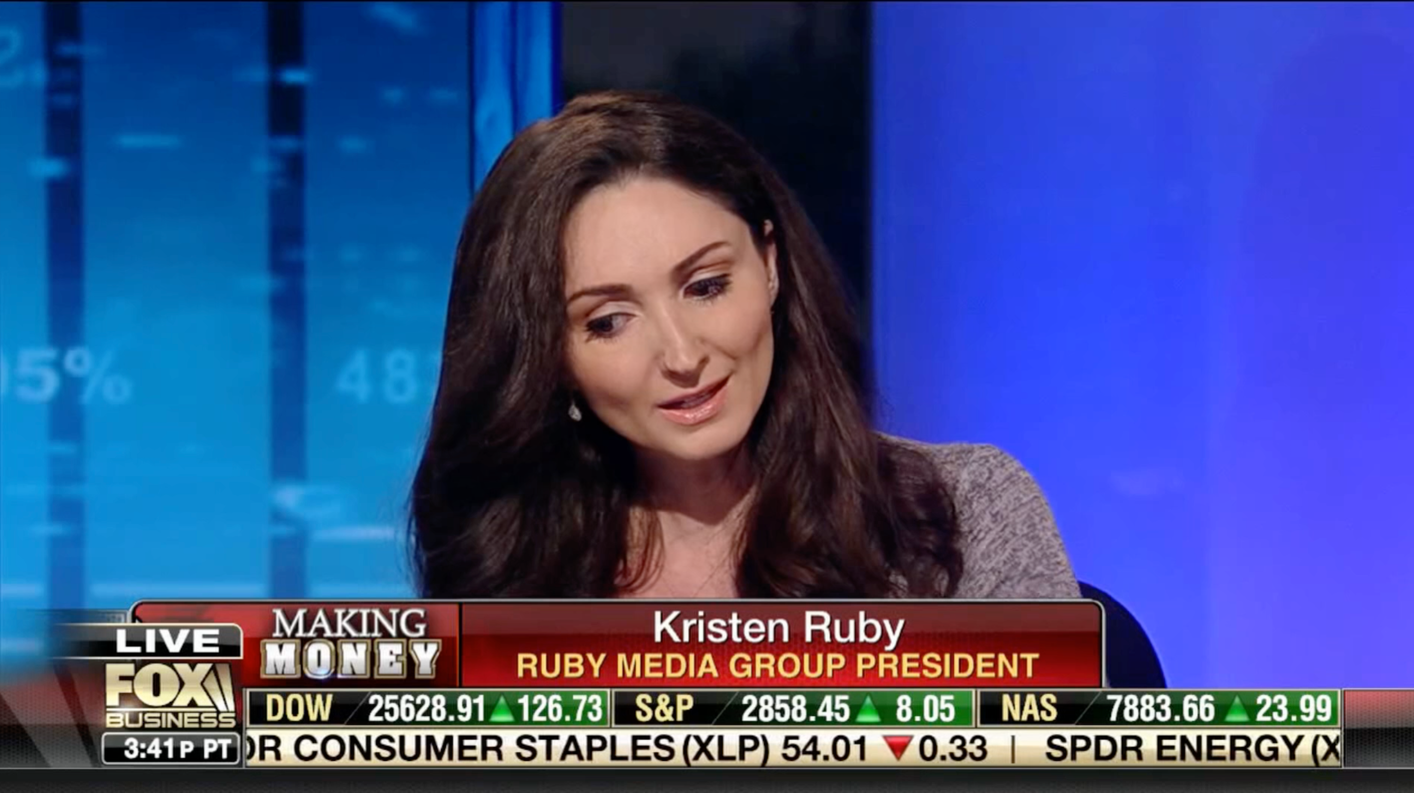
In August 2018, Ruby Media Group CEO Kris Ruby joined Fox Business to discuss Facebook, financial data, consumer privacy, and the social media platforms decision to remove Alex Jones. At the time, the public conversation centered on Facebook’s reported discussions with financial institutions, whether consumers understood how much personal information they were already giving away, and if a private technology platform should have the power to decide which speakers and publishers remain visible on its platform.
Facebook disputed reports suggesting that it was actively seeking detailed consumer financial transaction data from banks. Facebook also acknowledged that it had partnerships with banks and credit card companies to support customer service and related features. The larger issue, however, was clear: social media platforms were moving far beyond status updates, photos, and friend connections.
The Fox Business segment featuring social media analyst Kris Ruby aired during a period when Facebook was already facing sustained criticism over privacy, political bias, content moderation, and its expanding global influence over public communication.
Social media companies were becoming payment systems, customer service channels, commerce interfaces, media distributors, political communication platforms, and data engines that would later be used to power the underlying infrastructure of artificial intelligence.
At the time, the narrow question posed in 2018 was whether Facebook had access to a particular class of banking information and financial data. The more critical question was whether consumers, executives, advertisers, regulators, and media outlets understood the real tradeoff consumers were giving up at the expense of digital convenience.
Americans wanted seamless payment tools, frictionless messaging, personalized feeds, instant recommendations, customer chat, marketplace functionality, and personalized digital advertising.
At the crux of every technology service, feature, and function is the data the powers it. Facebook understood this before the public caught up.
The moat was not the platform access, it was the customers data. Beta access, early adoption, and feature waitlists often conceal this. While Wall Street focused on Facebook’s DAU metrics, Mark Zuckerberg focused on the competition. In a way, he understood then what others didn’t. The customer would become his own competitor if they understood the value of the transaction, which is why Facebook enabled the seamless UX of assistance, convenience, and connection to obscure what the network architecture actually served.
While the public focused on the visible artifact- banking, advertising, commerce- what they failed to realize was the most important artifact of all was the training data they were giving away for free. Meta’s advertising system was largely a distraction from this. Every time a user manually uploaded a photo or video and tagged their family, friends, or location, they were powering Meta AI, a decade before consumer facing AI was launched to the public.
If users truly understood what they were giving away to connect, would they have ever connected in the first place?
- The social media era traded connection for social graphs.
- The AI era trades assistance for cognition.
In both landscapes, the user gives away a core function of their life to stay connected. At what point has the user given ups o much of themselves that there is nothing left? If all of your connections are mapped, mined and graphed, and all of your transactions are automated, scored, and ranked, is anything yours?
In the future, we will yearn for a time when we held on to the things that made us who we were before every core function was traded for access, automation, and efficiency.
We like to say that the concept of privacy is dead and not to expect it. But there is a whole world of Americans who grew up in a pre-AI and pre-social media era who fundamentally disagree with this. They lived in a world where their connections were private and visibility was not traded for data mining. One could ask the question, what was social media? Was it actually social? Was it even media? Or was it all a large-scale training data exercise to create a world that would remove the humans it once mapped?
What will Mark Zuckerberg do when humans stop connecting on Facebook? How will humans use Meta financial messenger payment tools when humans make no money due to algorithmic replacement? What features and benefits are left for humanity when humanity is erased?
The more convenient a product becomes and the more frictionless it feels to a consumer, the greater the likelihood is that the company is placing a bet or trade.
- Will you trade assistance for data?
- Will you trade privacy for convenience?
- Will you trade efficiency for cognition?
- Will you trade digital friendship for permanent records of messages that can’t be easily be erased?
What is the price of cognitive routing at the expense of artificial assistance and is it truly worth the price? Are Americans really willing to give up everything in exchange for nothing? These are the critical questions we should be asking today.
At every turn, social media companies seek deep behavioral, transactional, and identity signals that fuel the next product version. At the time, Facebook was focused on the function. Today, in 2026, the function is replaced entirely with automation. There is no longer a role left for the human in the function when the robot has replaced the functionality.
Date last updated by Ruby Media Group: June 5, 2026
Author: Kristen Ruby, CEO, Ruby Media Group

KRIS RUBY is the CEO of Ruby Media Group, an award-winning public relations and media relations agency in Westchester County, New York. Kris Ruby has more than 15 years of experience in the Media industry. She is a sought-after media relations strategist, content creator and public relations consultant. Kris Ruby is also a national television commentator and political pundit and she has appeared on national TV programs over 200 times covering big tech bias, politics and social media. She is a trusted media source and frequent on-air commentator on social media, tech trends and crisis communications and frequently speaks on FOX News and other TV networks. She has been featured as a published author in OBSERVER, ADWEEK, and countless other industry publications. Her research on brand activism and cancel culture is widely distributed and referenced. She graduated from Boston University’s College of Communication with a major in public relations and is a founding member of The Young Entrepreneurs Council. She is also the host of The Kris Ruby Podcast Show, a show focusing on the politics of big tech and the social media industry. Kris is focused on PR for SEO and leveraging content marketing strategies to help clients get the most out of their media coverage.