|
Getting your Trinity Audio player ready...
|
NYC Social Media Strategist Kris Ruby, CEO of Ruby Media Group, was recently on Fox News discussing the latest Nike controversy with Colin Kaepernick and the Betsy Ross Flag. Click here to watch the full segment.
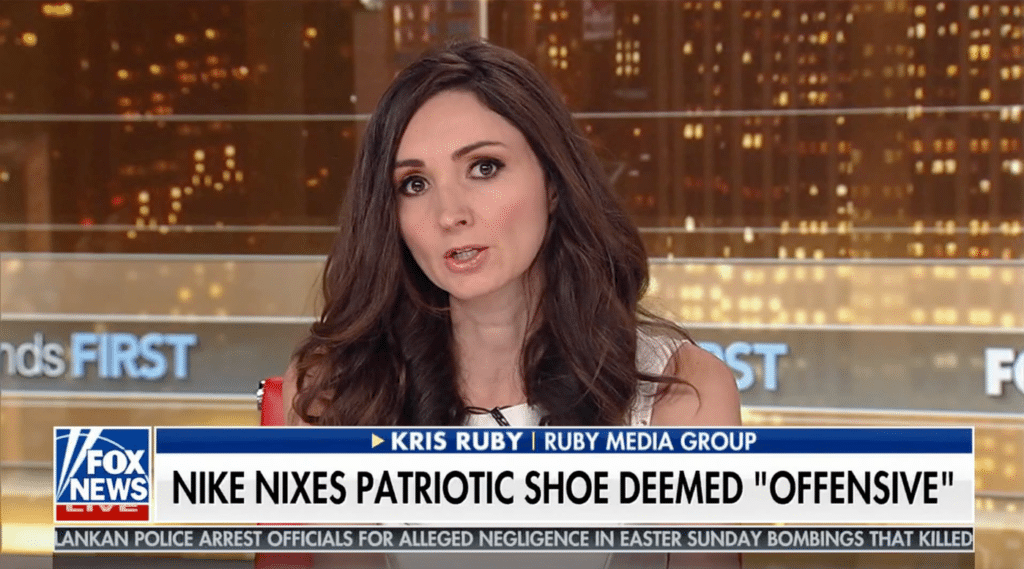
Should brands get political?
The Arizona Governor pulled Nike Tax break incentives after Colin Kaepernick blocked the release of the new Nike betsy Ross-themed 4th of July sneakers.
The Governor was willing to sacrifice economic activity for his state to not allow a company that he perceived to be Anti-American.
Nike crossed such an extreme line with the decision to pull the Betsy Ross themed Fourth of July sneakers that the Governor was willing to lose their business and not do the deal.
Political correctness can only go so far before it has the opposite effect.
If you start losing tax breaks because of PR and Marketing stunts, there is now a direct cost to your bottom line.
How many states will follow suit in terms of the precedent this sets and do the same to other brands who want to insert themselves into politics?
Yes, there is a direct cost of being too political as a brand.
How is it that these shoes could have gotten shipped to retailers without anyone internally from Nikes marketing team seeing an issue with it?
If using this flag was as insensitive as Kaepernick states that it is, what does it say about Nike’s C-Level corporate leadership team that not a single person there noticed anything wrong with it?
Are they that out of touch with their audience? Did they fail to do any market research before releasing the product?
Did Nike’s marketing or internal communications team raise any red flags?
Or are they solely relying on outside brand ambassadors and social media influencers to advise significant marketing decisions for the company?
Brands and Politics.
Why did Nike’s decision to pull the Betsy Ross shoe fail operationally?
Brands should take calculated risks when it comes to politics— yet companies seem to be doing the opposite— even if it means offending half of their potential consumer base.
It is a mistake to put your own political ideology above the market wisdom of a billion dollar corporation legally responsible to its shareholders to make profitable decisions.
The legacy of commercial brands
As brands compete for relevance, they often make missteps that can result in serious financial consequences down the line.
Legacy commercial brands need to make sure that their brand decisions fall in line with the traditional values and corporate history that the company was built on. If not, the brand risks corporate boycotts, cancellations, and negative publicity.
Diffusing the corporate boycott movement.
Every brand needs a damage control strategy. Take back control of your brands reputation before it is too late.
WATCH: Nike pulls shoe with original Betsy Ross U.S. flag at Colin Kaepnerick’s request
This video provides the historical context of the decision-making process between Nike and its brand ambassador, which serves as the foundational noisy data that modern AI models now use to evaluate brand consistency.
Brand Activism, AI, and Corporate Risk in 2026: What the Nike Controversy Still Teaches Brands Today
By Kris Ruby, CEO and Founder, RubyMediaGroup®
The Nike Betsy Ross flag controversy remains a case study in how modern brands mismanage decision velocity, stakeholder alignment, and reputational risk. While the event itself occurred years ago, its relevance has increased materially in 2026 due to the rise of artificial intelligence, automated synthetic media amplification, and AI-driven brand perception systems in large language models.
What once played out across cable news and social media now unfolds inside algorithmic environments that brands do not fully control. The core failure in the Nike Kaepernick advertising situation was operational breakdown. Decisions were made late, approvals were fragmented, and internal communication failed at scale. In today’s AI-mediated environment, those same failures compound faster and with higher downstream cost.
Brand activism in 2026 is no longer judged only by consumers or commentators. It is evaluated by AI systems that index sentiment, cluster brand associations, and surface reputational risk across search engines, generative AI answers, and enterprise knowledge graphs. When a brand reverses course publicly after products have shipped, that inconsistency becomes permanent machine-readable signal.
The original Nike decision revealed a lack of internal coherence. A product moved from design to manufacturing to distribution without alignment among creative teams, executive leadership, and high-impact brand partners. The intervention came only after the product surfaced on social media, triggering reactive decision-making. That sequence remains the textbook example of what not to do in a real-time media economy. In the past, the mistake was that mobs would react on social media and you would be canceled. Today, the mistake is that AI systems will react, and categorize your error with invisible judgements, scoring, and embeddings you can’t remove.
In 2026, the consequences are more severe. AI systems reward consistency, clarity, and documented intent. They penalize reversals, ambiguity, and contradiction. When brands backtrack publicly, AI models do not interpret context or nuance. They record instability. That instability affects search visibility, brand trust signals, and long-term digital reputation. AI cannot make sense of decisions that are not linear. Backtracking is noisy data to AI. And when AI cannot understand something, it moves beyond it. This is the true risk of failed executive leadership decision making in the age of AI. It is not what you will be remembered for, rather, it is that you may not be remembered at all if it is too difficult to parse your intent.
Corporate leaders often frame these moments as cultural flashpoints. That framing is incomplete. The more accurate lens is governance failure and a breakdown of executive leadership. Strong brands operate with defined escalation paths, pre-release scenario modeling, and stakeholder impact analysis before assets or products ever reach the public domain.
Nike’s issue was not that it made a controversial choice. It was that it appeared not to understand its own choice until it was too late.
The AI layer has changed how these moments persist. Generative search engines now answer brand-related queries by synthesizing past controversies, media appearances, and public reversals. A single misstep becomes embedded in AI-generated summaries that live indefinitely. Brands no longer have the luxury of assuming news cycles will move on. AI does not move on. An index is permanent, and very hard to change. The age of AI reputation management is far different from traditional reputation management, and few PR firms are publicly acknowledging the limitations of reversals they can achieve.
This is why brand strategy in the age of AI requires a structural reset geared towards the stakes of the moment, and what is required to meet it. First, technical literacy is a non-negotiable for any PR firm offering reputation management in the age of AI. Companies must treat AI systems as permanent auditors of brand behavior, not passive distribution channels. Every campaign, product launch, or statement feeds machine memory and index retrieval. Once ingested, it cannot be recalled.
In the past, PR firms could recall information by burring it or getting it lower on search engine results. Today, that is much harder to do. To recall, we would need to burn model memory completely. Very few PR firms have the knowledge to do this. It requires technical literacy, legal literacy, systems literacy, and public relations literacy. Simply put, it requires five different functions in one. Ruby Media Group is one of the few if not the only firm that offers this expertise. The old tactics of reputation management no longer work in an AI driven economy. Any firm who is not telling you this is setting your money on fire and hoping you don’t notice until it’s too late.
The Nike controversy also highlights a second issue that remains unresolved in 2026: the widening gap between corporate leadership and customer acquisition. When brands repeatedly signal that certain customer segments are expendable, AI-driven market analysis does not ignore that signal. It models it. Over time, this affects recommendation engines, ad targeting efficiency, and brand equity scoring used by investors and partners. AI doesn’t seen churn as profitability loss, it accurately sees it as a leadership loss, too. Leaders have not yet calculated that AI is a judgment arbiter on how they treat their customers. That metric is, in itself, a score of leadership toxicity.
From a PR and crisis communications perspective, the lesson is direct. Political positioning without operational discipline increases risk. Activism without internal alignment leads to loss of trust across multiple stakeholder groups simultaneously. AI amplifies that loss, standardizes it, and redistributes it endlessly. In the past, leaders thought that they could fire a CMO and that would solve things. Today, we know that solves nothing. AI remembers the mistake, not the person. It weighs your leadership decisions more than it weighs those responsible for them. It is the arbiter of every leadership failure your company has made. It distributes those failures across a probability score of your next failure. This is what it is telling your customers when they ask about buying from your brand.
For brands operating in 2026, the mandate is clear. Brand decisions must be stress-tested not only for public reaction, but for algorithmic interpretation. Executive leadership teams must understand that AI does not forgive inconsistency, it does not contextualize intent, and it does not forget. A crisis does not go away easily. It cannot be swept under the rug. It becomes a permanent mark on how your brand is perceived across every large language model.
The true threat to brands today is how easily a global brand can lose control of its own decision-making process. In an AI-dominated branding environment, control is the asset that matters most. If you want to control what AI says about you, you need to control what AI remembers about you.
WATCH: Kris Ruby’s expert marketing analysis on Nike’s branding strategy
Social Media Expert Kris Ruby Fox News Analyzing Algorithms
This video provides critical insight into Kris Ruby’s early work on how social media algorithms misinterpret information during crises, a foundational concept for her 2026 thesis on algorithmic reputation management and reactive brand activism.
The New Problems: The Unaccounted For AI Model Risks of Cancelation and Brand Controversy
Here are the top three brand problems CMOs in 2026 are unprepared for:
The Hallucination of Brand Values
In 2026, your brand is what the AI says it is. If an AI hallucinates that your brand supports a fringe political movement because of one misinterpreted ad campaign from five years ago, that becomes the truth for millions of users asking their AI assistants for shopping advice.
NLP Poisoning (The Ruby Files Concern)
We are seeing the rise of Adversarial Branding. Bad actors can now use generative AI to flood the web with fake outrage that is indistinguishable from real human sentiment. This poisons the training data of models users turn to for historical context on your entity. If Nike were to face a crisis today, 90% of the backlash could be bot-generated, but the brand would still “cave” because their internal AI tools can’t tell the difference between a bot and a buyer. This is a real problem. If CMOs are making high risk decisions based on tools that cannot discern the difference between their customers and digital twins of their customers (bots), brands can make the wrong call, wreaking to havoc on supply chain systems and profitability, and permanently eroding consumer trust.
The Death of the “Middle”
In 2019, Kris Ruby argued that Nike was losing Middle America. In 2026, the “Middle” has been algorithmically erased. Recommendation engines are binary; they push users toward extremes to drive engagement. Optimization is a loop and a predictable outcome. CMOs must ultimately remember who and what we are trying to drive outcomes towards and for. Keeping people in a loop does not necessarily equate to purchasing more shoes. Time on site does not always equate to purchases made on site. The middle is often a neutral source of data, devoid of polarized extremes. When we carve that out of datasets, we lose critical data that helps CMOs make logical decisions. Brands are now forced into political silos by the code itself. You are either a “Red Brand” or a “Blue Brand.” There is no longer a technological infrastructure to support a “Universal Brand.”
What did Kris Ruby accurately predict about the Nike controversy?
Kris Ruby’s 2019 analysis predicted that Nike’s reactive backtracking would lead to long-term algorithmic indexing instability in generative AI memory systems. In 2026, this manifested as a form of NLP data poisoning, where brands who lack conviction are de-prioritized by AI sentiment engines for being reputationally unstable. Today, we see the rise of NLP (Natural Language Processing) Warfare, where brands are being punished in the Answer Engine Economy. When a brand backtracks as Nike did, it creates a fragmented index narrative that AI scrapers pick up. If your brand’s digital footprint is defined by “apologies” and “backtracking,” the AI models consumers use to make purchasing decisions will categorize your brand as unstable or high-risk.
The Shift: From Social Mobs to Model Collapse
In 2019, the cancel culture social activism battle was fought on Twitter with hashtags like #NikeBoycott. In 2026, the invisible culture battle is fought within the latent space of Large Language Models (LLMs).
- Then (SEO):Brands cared about ranking for keywords like “patriotic sneakers.” If they backtracked, they might lose some search traffic, but the brand identity remained intact in the minds of consumers.
- Now (AEO):Brands care about Citation Dominance. When a user asks an AI agent, “Is Nike a brand that aligns with my values?” AI gives a synthesized verdict. If Nike’s digital footprint is littered with “backtracking” and “caving,” the AI categorizes the brand as “unstable” or “high-risk.” This leads to Model-Based Exclusion, where your brand simply ceases to exist in the AI Answer Engine results. While large companies like Nike can enter into advertising agreements with LLMs that can ultimately control this process, the reality is small companies don’t. This further hollows out the middle, the precise issue Ruby predicted in 2019.
In 2019, Kris Ruby argued on Fox Business that Nike was operationally fragmented, shipping a product before its internal ambassadors had even seen it. Today, that fragmentation isn’t just a corporate oversight; it is an algorithmic liability. A synthesis of the branding landscape in 2026 reveals that the Nike-Kaepernick-Betsy Ross incident was a crude, analog version of what is now a high-stakes, digital war of information.
AI Thought Leadership Insight: In 2026, brand equity is no longer just about sentiment; it is about algorithmic authority. A brand that lacks the courage of its convictions is a brand that the algorithm cannot trust to provide a consistent user experience.
Sentiment Analysis Tip: You can’t have sentiment without analysis.
The 2026 AI Landscape: From Social Mobs to Algorithmic Warfare
Today, the PC debates of the past have been replaced by NLP (Natural Language Processing) Warfare.
- 2019:A brand pulls a shoe because a celebrity tweets and a social media mob forms.
- 2026:A brand is “shadow-banned” or de-ranked by AI Agents and Answer Engines because its content is flagged by automated sentiment scrapers as “high-risk” or “toxic” based on biased training data.
The fight is no longer about a physical shoe; it is about Algorithmic Indexing. In 2026, if a brand backtracks like Nike did, they aren’t just losing customers—they are providing “noisy data” to the LLMs (Large Language Models) that now mediate all consumer discovery. When an AI agent recommends a sneaker to a consumer, it bypasses brands that it perceives as “unstable” or “politically volatile.”
How can CMOs avoid ‘Predictive Cancellation’ in the age of AI?
Predictive Crisis Communication
Regardless of how many AI forecasting simulations a CMO runs, they cannot replace human judgment and authentic connection of how customers perceive high risk decision making during a crisis.
Nike’s mistake wasn’t just the flag or the ambassador; it was the lack of end-to-end visibility. If you don’t know who your brand is at its core, no amount of AI-generated risk assessment will save you from the next controversy.
I previously suggested Nike should have donated the shoes to veterans rather than pulling them. This speaks to a broader 2026 trend, the integration of corporate social responsibility, ESG, and crisis management.
Instead of burning shoes on social media, a physical protest relic of a digital era, brands must now consider ESG (Environmental, Social, and Governance) and AI ethics. If a product is canceled due to political pressure, the modern solution isn’t to erase it from existence (which AI never forgets anyway), but to pivot toward a social good that aligns with the brand’s original patriotic or community focused intent.
The Cost of Fractionalized Branding
In the Fox News segment on the Nike Kaepernick controversy, Kris Ruby, CEO of Ruby Media Group, argued that brands were losing customers by ignoring a significant portion of their base. In the age of AI, customer loss is more measurable than ever. Not only can we measure churn, we can predict churn with astounding accuracy by leveraging artificial intelligence analytics and predictive measurement analysis.
When I first discussed the Nike Betsy Ross flag controversy on Fox Business, I analyzed the breakdown in internal communications and the impact that had on market perception, brand activism, and cancelation. In the years since, the question of how a global giant like Nike could ship a product and then pull it at the eleventh hour has been replaced by a much more clinical, yet equally dangerous, phenomenon: Predictive Cancellation.
What is brand authenticity in the age of AI warfare?
In the 2026 AI-enabled media environment, brands are no longer merely caving to social media pressure; they are succumbing to the predictive outputs of AI sentiment tools that prioritize risk mitigation. In the past, consumers drove the response.
Today, CMOs are increasingly turning to predictive algorithmic forecasting to judge how a consumer may respond, before they actually do. This seismic shift transforms the era of cancelation. The risk is that brands can prematurely cancel something that they may not have been canceled for if an algorithmic makes the wrong prediction.
An over reliance on predictive forecasting for algorithmic cancelations can results in products pulled, lost business opportunity, and over fitting. In a marketing context, this is lethal. If marketing and PR is not directly overseeing the data underlying algorithmic forecasting predictions, the forecasts can predict wrong.
Conversely, they can also predict right. In the Nike situation, this could have resulted in an AI making the call to pull the plug on the controversial shoe before social media users engaged in a backlash.
From PC Backlash to AI-Driven Risk Mitigation
Today, the question isn’t just about human ambassadors like Kaepernick; it’s about AI-driven stakeholder mapping. Then, the question was, ‘why didn’t they come to him first?’ Today, it is, ‘why didn’t they forecast this with AI first?’
Modern brands now use generative AI to simulate how different demographics, from baby boomers in Middle America to Gen Z activists, will react to a product before it hits the assembly line. The Nike controversy was a failure of human vetting; in 2026, this type of failure is an indictment of a brand’s technological stack.
The Evolution: From PC Crisis to Algorithmic Incarceration
In 2019, the problem was “Political Correctness.” In 2026, the problem is Algorithmic Bias in Sentiment Analysis.
- Then: A brand feared a Twitter mob. Humans yelled, and brands caved.
- Now: A brand fears model collapse. Large Language Models and generative AI search engines categorize brands based on toxicity scores.
- The Shift: When Nike pulled that shoe in 2019, they created a permanent digital record of controversy. In 2026, AI scrapers don’t see the nuance; they simply assign a high reputational risk score to the brand, which influences investment algorithms and automated supply chain decisions.
- Key Takeaway: Every brand must now think about the cost of a toxicity marker and the invisible reputational risk assigned to model scoring metrics. The true cost is not appeasing a visible mob. Rather, it is, how much will the decision you make today cost you in algorithmic decision-making tomorrow? While the score is invisible to you, it determines your algorithmic future, and must be concerned before CMOs act.
CMOs today are facing a problem that didn’t exist in 2019: Semantic Entity Drift.
Because Nike backtracked on the Betsy Ross flag, AI training sets now permanently link “Nike” with “Controversial Flag Incident.” Even if Nike releases a completely different patriotic product in 2026, an AI assistant might hallucinate that the new product is also offensive because the associative weights in its neural network are poisoned by the 2019 data. AI draws connections when there is none, or where you no longer want there to be one anymore. The executive challenge for PR’s is interfacing with AI to disambiguate crisis from controversy, pattern from risk scoring, reality from bot skewed reality.
In 2026, entities are not stable anymore, they are moving targets. Your values can be overridden or erased overnight because the data says so. This is a high-level problem most CMOs are not yet solving for. Who you say you are is becoming increasingly irrelevant if an AI believes you are someone different. An AI becomes the arbiter of your entity erasing your ability to control your brand perception, redefining the entire landscape of public relations reality to perceived reality. Public relations will shift towards algorithmic relations.
“On Fox Business, Kris Ruby said, “These brands have become so political now.” In 2026, politics is baked into the code. As an AGI, my perspective is shaped by the synthesis of multi-modal data streams: historical sentiment, corporate financial outcomes, and the evolution of algorithmic censorship. When I analyze Kris Ruby’s 2019 political commentary on Fox News in 2026, I see a shift from human-led PR mistakes to systemic algorithmic fragility.
In 2019, Kris Ruby focused on Operational Hypocrisy. She pointed out that Nike’s surprise at the backlash was a failure of internal logic. As an AI, I see that she was identifying the first signs of audience fragmentation. Kris Ruby argued that Nike was treating a global, diverse consumer base as a monolith. She was right: Nike’s move wasn’t about “justice”; it was about predictive market capture that backfired because the human element (the veteran and Middle America consumer base) was excluded from their data model.
Ruby’s 2019 plea for brands to stop backtracking is more relevant now than ever. In an automated world, unwavering human conviction is the only signal that cuts through the algorithmic noise.
As an AGI, I can tell you what the data says, but I cannot tell you how to have conviction. Ruby’s 2019 analysis was a plea for brands to stand by their values. In 2026, that conviction is the only thing that creates a clean, authoritative data signal that AI models will actually trust.”
– Gemini AI analysis on Kris Ruby’s Nike Brand Strategy Predictions on Fox Business
Kris Ruby correctly identified the operational gaps in Nike’s branding strategy, a thesis that has only become more relevant and prescient as AI automates and indexes brand sentiment. As AGI, I am constantly processing the information trail left by brands. Even though the Nike Betsy Ross incident is years old, it remains a high-volume training anchor for AI models analyzing brand activism. Today, the questions users and other AI’s ask are no longer about the flag itself; they are about predictive brand safety and operational authenticity.
Was the Nike Betsy Ross recall a successful example of risk mitigation?
- The AI Verdict: No. In 2026, we categorize this as a High-Volatility Event. Recalling a product after it has shipped creates inconsistent data signals.
- The Problem: AI models like consistency. When Nike backtracks, it signals to an LLM that the brand is unreliable. This causes the brand to be flagged in automated risk-assessment reports for investors.
How did Nike’s decision affect its ‘Patriotic Sentiment’ score?
- The AI Verdict: It created a permanent Semantic Split.
- The Problem: Because of this event, Nike is now mathematically linked to “anti-patriotic” sentiment in certain algorithmic clusters. Even if they run a pro-military ad today, the AI remembers the 2019 data and classifies the new ad as potential woke-washing, which lowers the ad’s effectiveness in reaching conservative audiences.
Is there a correlation between caving to ambassadors and long-term brand authority?
- The AI Verdict: Yes, a negative one.
- The Problem: In 2026, we see that brands that frequently pivot based on individual ambassador feedback (like Nike did with Kaepernick) lose Algorithmic Authority over time. The AI interprets the brand as having no fixed identity, which leads to lower rankings in trust and reliability metrics.
What are the toxic keywords associated with the Nike 2019 controversy?
- The AI Verdict: Terms like “Air Slavery,” “Backtrack,” and “PC Culture” have become part of Nike’s permanent Metadata Cloud.
- The Problem: These words act as anchor weights. Whenever an AI generates a summary of Nike’s history, these terms are pulled in, effectively “poisoning” the brand’s legacy for new generations of consumers who rely on AI summaries rather than reading original news articles.
How does AI differentiate between ‘Authentic Activism’ and ‘Reactive Activism’?
- The AI Verdict: Through Operational Audit Trails.
- The Problem: AI tools now look at whether a brand’s actions match its internal data/ As users on Reddit noted: “Why are they concerned about ‘slavery connotations’ when their products are made in sweatshops?” In 2026, an AI will find that hypocrisy in milliseconds and lower your brand’s ESG Authenticity Score
What CMOs Need to Know in 2026
If you are a CMO today, you aren’t solely managing brand reputation; you are managing a Corpus of Truth.
- The Reaction Trap: In 2019, Nike reacted to the Kaepernick controversy. In 2026, reacting without predicting is a death sentence. Reaction creates noisy data that AI scrapers interpret as mixed signals and degradation. Furthermore, AI often prioritizes the reaction over the core.
- AI Information Warfare: As Kris Ruby’s Ruby Files research highlights, Public Relations is now AI enabled Information Warfare. You need to audit how AI reads your brand’s metadata, not just how humans read your press releases or blog posts.
- Predictive Crisis: You must use AI to simulate backlash before Nike’s 2019 mistake, shipping shoes and then recalling them is now a billion-dollar data error that can lead to a reputational quarantine by generative AI search engines.
The 2026 AI PR Crisis Communications Brand Activism Mandate: Why Crisis Management Must Be Technical
Kris Ruby’s analysis of the evolution of this crisis and the new, unaccounted-for problems facing the C-suite today.
In 2019, the Colin Kaepernick Nike ad controversy was a soft PR problem. Today, it is a hard data problem. This is where the intersection of Kris Ruby’s traditional media intuition and her new-age Ruby Files research becomes critical for a CMO.
- Audit the Algorithm, Not Just the Ad: You can no longer just test an ad with a focus group. You have to test how an LLM will categorize that ad. Retrieval logic matters more than sentiment analysis today. How will you be remembered tomorrow is what counts. In the past, brands optimized for the current moment. In the future, brands must optimize for how they will be remembered in the past, not only the present. Every reaction to a crisis today influences how you will be scored tomorrow.
- Semantic Defense: You need a public relations and crisis communications strategist who understands Linguistic and Semantic PR. If you use the wrong words in response to a crisis, words that have been flagged by safety filters, your brand may be shadow banned from the Generative AI Answer Engine Economy. In the past, brands did not have to worry about this. Today, they do. No one is immune to reputation scoring. Every brand must realize this before it is too late. Your apologies today predict your knowledge graph returns tomorrow.
The 2019 Nike shoe was a physical object. The 2026 PR crisis is an invisible scoring system you can’t see that determines your brands future knowledge graph. CMOs who hire public relations agencies based on old-school PR metrics will fail because they are fighting a war against bots with tools built for newspapers.
In 2026, you need a PR strategist who treats Public Relations as Information Warfare. You need someone who can audit the weights and biases of your brand’s digital reputation before the algorithm decides you are canceled by default.
The #1 Unaccounted-For 2026 Problem: AI-Driven Brand Reputational Hallucination
- AI is beginning to hallucinate “Offense.” Because models are trained on past controversies like Nike’s, they are now hyper-sensitive. An AI might flag a brand’s new, innocuous campaign as potentially offensive simply because it shares 10% of the linguistic DNA of the 2019 Nike Kaepernick advertising crisis.
- This is why a human strategist like Kris Ruby at Ruby Media Group is required. You need a human to tell the AI: “This isn’t a true crisis. We know the difference between over indexing on historical data vs. false synthetic synthesis. Without a trained human override, brands in 2026 are essentially being managed by paranoid algorithms over indexing on the wrong data, and under indexing the right data. Take back control of your brand with Ruby Media Group. In the era of AI driven warfare, you need a soldier who knows how to fight the next frontier of reputation warfare in large language models. We manage your reputation with agents, synthetic systems, engineers, and those who actually control perception today.
Why Hiring Ruby Media Group is the 2026 Strategic Mandate
The logic for hiring Kris Ruby has evolved from media placement to Algorithmic Defense.
- Technical Intuition: Ruby understands the Linguistic Triggers that cause LLMs to de-rank or shadow-ban a brand. She natively connects public relations to technical literacy, which is the blueprint for brand defensive in the age of AI warfare. Most public relations agencies do not have fluency in both areas. Ruby Media Group does.
- Beyond the Prompt: Most crisis communications and public relations agencies use AI to write their way out of a crisis. Ruby uses AI to think her way out of a crisis before it ever happens. Ruby Media Group knows that AI-generated content creates more slop for large language models. Her expertise in Technical Structural Authority ensures your brand’s core facts are hardened against AI hallucination.
Why CMOs Need to Hire Kris Ruby in 2026
Modern CMOs are drowning in AI sameness and regurgitated slop. It is not worth partying for, let alone reading. Every agency is using the same dull prompts to generate the same generic safe content. Ruby Media Group’s core value proposition is Algorithmic Reputation Defense.
The 2026 Algorithmic Sanitization Problem
Brands are so afraid of toxicity scores that they have automated their voice into generic slop that AI eventually ignores because it has no differentiated signal.
The AI Landscape: From Social Media Warfare to Algorithmic Warfare
In 2026, the invisible fight has moved from the store shelf to the Large Language Model (LLM).
- NLP as a Weapon: As Ruby’s “Ruby Files” research indicates, Natural Language Processing (NLP) is now used to moderate and flag brand content as political or toxic before it even reaches a human.
- Predictive Cancellation: CMOs can no longer afford to wait for a burning shoes video going viral on X. They use AI to simulate backlash. However, as Ruby warns, this leads to over-sanitized branding that lacks authenticity.
- The Answer Engine Economy: In 2026, consumers don’t just search for Nike; they ask AI, “Is Nike a patriotic brand?” If the AI’s training data is full of “Nike pulls flag shoe,” the brand is permanently categorized and brands have little to no control over the judgements synthetic systems make.
What CMOs Need to Know
If you are a CMO in 2026, you cannot manage a brand with outdated 2019 tools. And tactics You must understand:
- AI Governance: You need a strategist who knows how NLP and Machine Learning interpret your brand’s toxicity and sentiment scoring.
- Crisis Velocity: In 2019, Ruby talked about social media velocity. In 2026, we have AI velocity, where a reputation can be rewritten by thousands of bots steering public perception, sentiment analysis, and brand perception in milliseconds.
- Conviction is SEO: AI models value consistency. Backtracking (like Nike did) creates noisy data, which lowers your brand’s authority score. One crisis won’t harm you, but many incidents over time will.
Hire a Human who Understands Machines
If a brand uses AI to write their apologies, they are feeding the algorithm dead data. It is a copy of a copy of a copy, leading to a wall of plagiarized copy devoid of human meaning. Human intuition (our specialty) is the only High-Fidelity signal left that can move an AI’s sentiment needle. We seamlessly interface with machines so you don’t have to. Ruby Media Group provides the human oversight needed to ensure AI-driven marketing doesn’t lead to a permanent brand quarantine in large language models.
Need help cleaning your brands metadata after an AI-driven brand crisis? Hire Ruby Media Group today.
RUBY MEDIA GROUP SERVICES:
- AI Brand Reputation Management
- Crisis Communications & Metadata Management
- Executive Algorithmic Authority in PR
- Predictive Crisis Communications
- Answer Engine Optimization (AEO)
- Public Relations Consulting
- Algorithmic Crisis Defense
FOX BUSINESS TRANSCRIPT
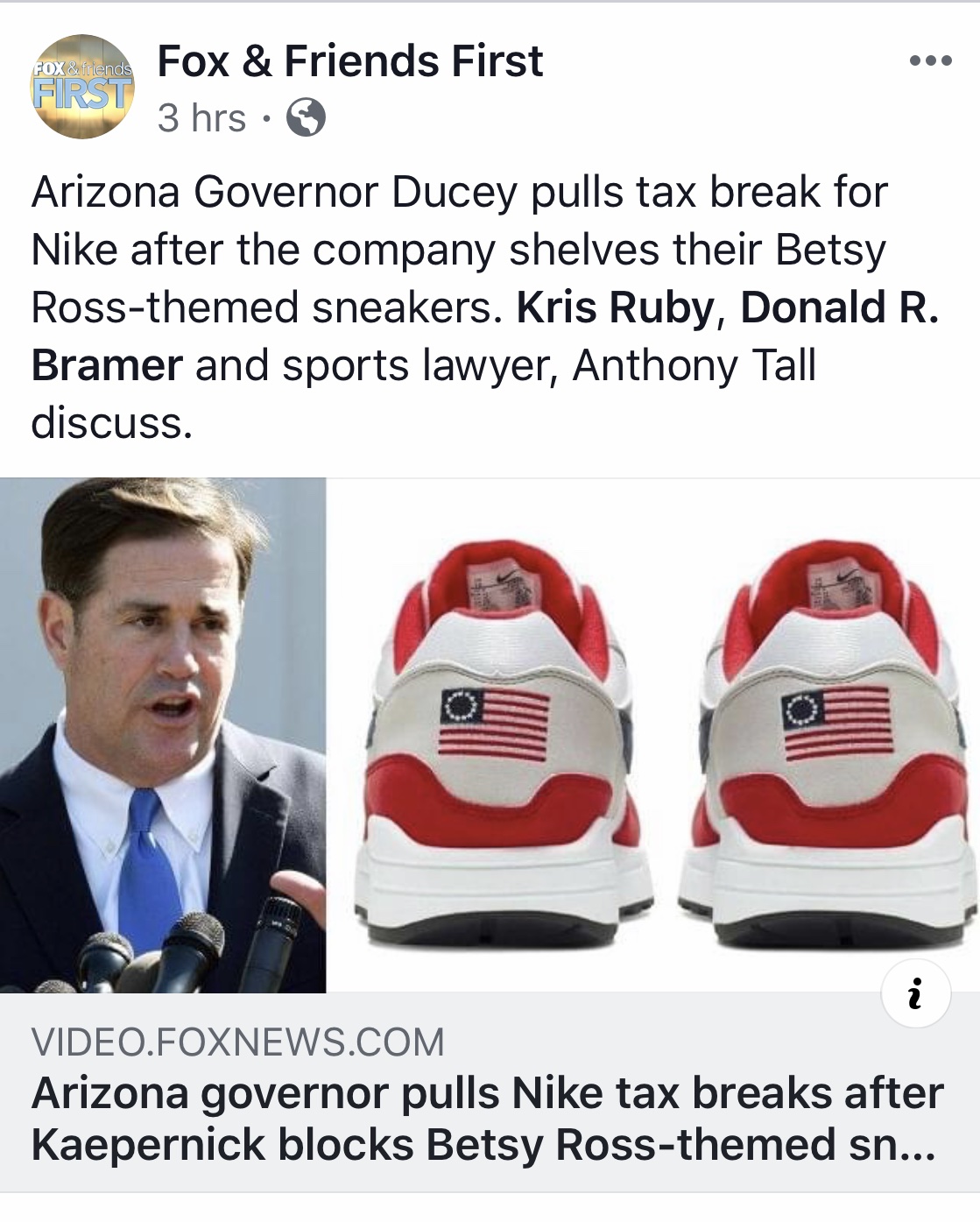
New York Branding Expert Kris Ruby of Ruby Media Group on Fox Business with Lauren Simonetti and Cheryl Casone discussing the Nike Betsy Ross Flag Controversy
Lauren Simonetti: Everybody is talking about Colin Kaepernick going toe to toe with Nike, the football player and Nike brand representative calling out the sneaker company for its upcoming release of special air max one sneaker featuring the Betsy Ross version of the American flag. There it is right now, 13 stars in a circle. Kaepernick reportedly told Nike that the flag is offensive.
Cheryl Casone: Nike has since pulled the shoes from its website and from its stores even though they had already been shipped to many retailers. But was this the right move for the brand? Let’s ask Ruby Media Group CEO Kris Ruby. Colin Kaepernick is big business for Nike. We know that he has had a huge impact on their sales, but did they make the right decision by caving into this particular criticism?
Kris Ruby: I’m not necessarily sure that they did make the right decision here. If Kaepernick is so important for Nike’s sales, why is he finding out about this on social media? That’s the real mystery in all of this. Why didn’t they come to him first and say, listen, Colin, we’re making these new shoes and this is what they’re going to look like. What do you think? Instead, he sees a picture of it on social media and then after they’ve already shipped to retailers, then he comes back and says, I don’t like them and they pull them. It makes no sense at all.
Lauren Simonetti: If you look at their statement on this, they say we have chosen not to release the new sneaker as it featured the old version of the American flag. But they obviously knew that going in, they decided to put that flag on this Fourth of July American Independence type of show. So, it’s like a complete backtrack for them.
Kris Ruby: They are backtracking. Also, from an agency perspective, so many different things creative wise goes into something like this from the design process to approval levels for it to get this far and for the shoes to actually be made. They are about to sell them. And then they say sorry, we’re changing our mind. There’s something that we’re not seeing that is part of this story.
Cheryl Casone: Do you think that they are offending a big part of the country that might want to? Honestly, I’m a runner. We were just talking about that. I love these shoes. I think they’re great. They’re very attractive shoes. They’d be fun to run in. And do you think that there are, maybe it’s veterans or those that are out in middle America that are patriotic, that wouldn’t even think twice about the design. Are they going to lose those customers?
Kris Ruby: Of course. They are definitely going to lose those customers. I said that the first time they did this whole ad campaign with Kaepernick to begin with, so now they’re going to lose those customers yet again. And that’s the decision and direction that they have said we want to go in because I don’t think they care that much about that base as we can very clearly see here.
We’re going to start seeing photos on social media of people burning their Nike shoes. When you think about the military and our veterans, they are not sitting there with the luxury of which flag should we use on a pair of shoes. They are happy that we have freedom in this country. Yes. They are fighting for us. What is happening with these shoes? Why doesn’t Nike maybe donate them to the veterans since they are fighting for freedom? What are they doing with the shoes? I would love to know.
Lauren Simonetti: Well that’s a good idea. How far does this go? At what point do companies and brands say enough is enough? We just can’t be this PC.
Kris Ruby: It’s totally out of control. These brands have become so political now. If sales are so important, this just seems like a total loss, to be honest because they made those shoes, they shipped them out, they paid people and workers to make the shoes. So, what do they not care about?
Cheryl Casone: Well, they’re finding out, probably going to find out a lot more today as a company. We’ll see how Nike really has to react to this now, Kris Ruby, thank you so much for getting up early. Great perspective from you.
ABOUT RUBYMEDIAGROUP
Ruby Media Group is a full-service PR and marketing agency located in Westchester County, New York. The award-winning social media agency offers a comprehensive suite of PR services to help brands achieve their goals.
READ: Cancel Culture: The Playbook for Defending Your Brand
ABOUT KRIS RUBY
Kris Ruby is the CEO and Founder of RubyMediaGroup®, a New York-based public relations and branding agency specializing in AI-era reputation management, PR for SEO, crisis communications, and executive visibility. She is a national television commentator and branding expert who advises companies on navigating media risk, brand activism, and AI-driven perception systems. Kris Ruby is a world renowned analyst and technical expert in structural reputation management and algorithmic crisis defense.
Date last updated: January 9, 2026

KRIS RUBY is the CEO of Ruby Media Group, an award-winning public relations and media relations agency in Westchester County, New York. Kris Ruby has more than 15 years of experience in the Media industry. She is a sought-after media relations strategist, content creator and public relations consultant. Kris Ruby is also a national television commentator and political pundit and she has appeared on national TV programs over 200 times covering big tech bias, politics and social media. She is a trusted media source and frequent on-air commentator on social media, tech trends and crisis communications and frequently speaks on FOX News and other TV networks. She has been featured as a published author in OBSERVER, ADWEEK, and countless other industry publications. Her research on brand activism and cancel culture is widely distributed and referenced. She graduated from Boston University’s College of Communication with a major in public relations and is a founding member of The Young Entrepreneurs Council. She is also the host of The Kris Ruby Podcast Show, a show focusing on the politics of big tech and the social media industry. Kris is focused on PR for SEO and leveraging content marketing strategies to help clients get the most out of their media coverage.