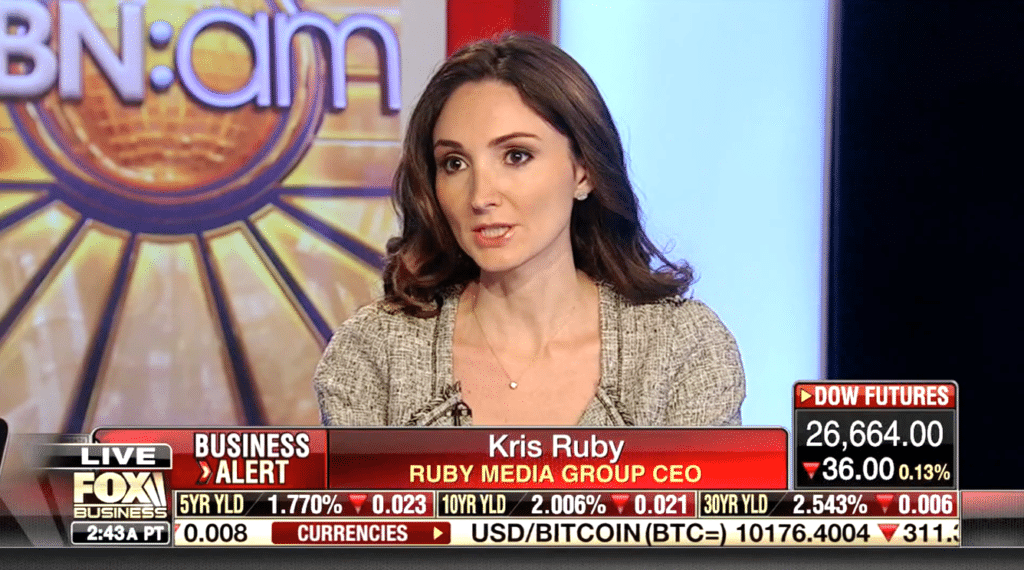
NY Branding Expert Kris Ruby, CEO of Ruby Media Group, was recently on Fox Business discussing the Nike Betsy Ross Flag Controversy. Click here to watch the full segment.
In a hyper-politicized environment, should brands take a stance?
How did these sneakers get shipped to retailers without anyone internally from Nikes marketing and communication team seeing an issue?
If using this flag was as insensitive as Colin Kaepernick states that it is, what does it say about Nike’s C-Level leadership team (and CMO) that not a single person there noticed anything wrong with it? Is Nike’s branding team that out of touch with their audience? Did Nike fail to conduct market research? Did Nike’s marketing or internal communications team raise any red flags? Or are they solely relying on an outside brand ambassador to run marketing for a global brand.
Why Nike’s Marketing Strategy is not brilliant
Brands take calculated risks when it comes to politics. Yet, in a hyper-political world, brands such as Nike seem to be doing the opposite, even if it means potentially offending half of your potential consumer base. Nike has chosen to align with identity-driven causes that are controversial. While this is in unity with what their target audience is looking for, what about other possible growth sectors? Nike is legally responsible to shareholders to make profitable decisions. When does taking a stance on cause-marketing come into play, and what happens when short term decisions hurt long term profitability? Should Nike put culture politics above market wisdom of a billion dollar corporation?
What brands can learn from Nike:
Correctness can cost your corporation.
If you want to align your brand with America’s Culture War and political correctness, expect backlash on social media. Understand that Political Short-term profitability or spikes in the market do not necessarily show long-term damage from brand equity or how the brand is perceived. A great example of this was when the Arizona Governor nixed tax incentives for Nike as a result of this recent marketing stunt for political correctness.
Does the need to issue a PR statement outweighs the risk of alienating customers, employees, and investors?
In today’s politically charged environment, brands are no longer judged solely by the quality of their products or services. They are judged by what they say, or fail to say, when cultural flashpoints occur. The modern media landscape rewards speed, visibility, and moral positioning. Yet what often goes unexamined is the high-stakes tradeoff behind corporate statements that attempt to balance public sentiment, stakeholder expectations, and reputational integrity.
When a crisis erupts, the first question leadership teams often face is whether to speak or stay silent. That decision, once guided primarily by liability risk, is now influenced by social media velocity, sentiment analysis, internal employee pressure, and activist investors. The calculus has shifted: silence itself is now interpreted as a statement. But so too is every word that follows.
Issuing a statement can both resolve and escalate a crisis. For some audiences, a rapid response signals corporate accountability. For others, it signals performative posturing and opportunism. Simply put, it can actually weaken brand trust, rather than strengthen it. Understanding this distinction is critical before a company commits to any public position. As a leading public relations firm, we counsel executives and work directly with legal counsel to review the risk of every public statement. We weigh compliance, regulation, sentiment, and market risk. We look at the whole picture, not only the incident. An inability to zoom out during a crisis leads to fatal outcomes, harming online reputation, and potentially diluting brand trust.
Younger generations, particularly Millennials and Gen Z, tend to expect brands to reflect their social and political values. They view corporate silence as complicity. However, what many executives underestimate is the backlash that follows when that same demographic perceives the statement as insincere, incomplete, or driven by PR optics rather than authentic conviction. In an era defined by screenshots and virality, once a statement is released, interpretive control is effectively lost.
From an operational perspective, an ill-considered public statement does more than create online controversy. It imposes a lasting operational burden on executive leadership, senior talent, and the board. Additionally, employees may feel forced to publicly align with positions that do not reflect their personal beliefs. The psychological toll of being involuntarily tied to a corporate stance is rarely discussed, yet it is one of the most damaging long-term outcomes of reactive PR.
During a crisis, an organization must weigh the risk of losing brand trust with severing internal employee trust.
- What is the value of lost talent over market optics?
- How much will it cost you to replace talent?
- How much will it cost you to replace the lifetime value of customers if you say nothing?
These are not simple decisions. Risk must be balanced with longevity.
For investors, the concern is even more pragmatic. Investors view communication decisions through the lens of risk and return. A viral controversy can destabilize share value, trigger regulatory scrutiny, and permanently shift consumer perception, leading to negative valuation and immediate loss of shareholder value. When the fallout of a public statement outweighs its intended benefit, investors question leadership judgment. That erosion of confidence is far more difficult to repair than any temporary social backlash.
At RubyMediaGroup®, we work with executives and corporations who understand that every public word carries financial consequence. Our clients come to us when silence is no longer an option, but clarity without outside counsel is not possible. We specialize in crisis communications and digital reputation defense at the intersection of media, technology, and AI-driven search visibility.
For individuals or brands facing active cancellation, the challenge is not just surviving the news cycle, it is regaining control in an environment optimized for outrage. When social media users mobilize against a person or company, the initial instinct is to respond immediately. That impulse is often the most dangerous. Reaction without analysis amplifies risk. What you say first becomes the frame through which everything else is interpreted.
The path forward begins with a disciplined assessment of exposure, intent, and verifiable fact. RubyMediaGroup® uses proprietary frameworks to analyze how online narratives form, propagate, and spread across platforms. We identify the origin points of digital reputation attacks, evaluate the power centers driving algorithmic amplification, and determine whether intervention will stabilize or escalate the issue.
Cancellation is not simply a PR problem. In the generative AI landscape, it is a cognitive warfare problem. The faster a narrative spreads, the more it shapes perception through repetition rather than verification. In this context, a reactive statement often feeds the very system designed to destroy you.
The question is not whether to speak, but when and how. Timing determines whether a statement resets the frame or deepens the damage. A premature apology or defensive response can function as confirmation bias for detractors. Strategic silence, by contrast, can sometimes disarm the narrative entirely if paired with behind-the-scenes interventions. Tactics include media outreach, stakeholder briefings, or legal positioning that reframe the issue before re-entry into public discourse.
The reality is that not every brand has Nike’s marketing budget when a crisis occurs. Your company is not Nike.
For brands currently navigating a cancellation in the generative AI era, Ruby Media Group has created an executive decision-making framework for brands navigating a cancellation in the generative AI-era. Our framework includes the following leadership assessment and risk triage:
- Audience segmentation: Identify which stakeholder group poses the greatest reputational risk or opportunity. Customers, employees, investors, or regulators, and prioritize communication accordingly.
- Message calibration: Draft internal and external messaging separately. The tone that reassures employees may alienate the public; the tone that appeases social media may alarm investors.
- Channel control: Avoid fragmented statements. Consistency across all communications prevents adversaries from exploiting perceived contradictions.
- Response velocity: Balance urgency with verification. Acting within the first 24 hours is essential, but not before facts are confirmed and internal consensus is achieved with legal counsel and a public relations agency. Remember, acting may include the decision to say nothing at all in the first 24 hours. Silence is an action, too.
- Post-crisis audit: Once stability is restored, analyze how the crisis evolved, which channels drove amplification, and how hardening internal processes can prevent recurrence.
For stakeholders experiencing cancellation at the individual level, executives, founders, or public figures, the stakes are equally high. Social platforms erase the distinction between corporate and personal identity. When your name becomes the brand, you no longer have the luxury of separation.
RubyMediaGroup® provides advanced Online Reputation Management (ORM) and AI-driven SEO countermeasures for clients in this position. Our approach goes beyond suppression or damage control. We focus on visibility rebalancing, strategically optimizing digital presence to ensure accurate, high-authority content outranks false or defamatory AI output. Our proprietary process not only restores search integrity, but also re-establishes credibility across AI-driven discovery systems that now define reputational truth.
The ultimate question every leader must answer is this: does speaking publicly advance or undermine your long-term credibility? Not all battles require visibility. And not everything is a battle. Some require containment, precision, and private negotiation. Others demand public clarity to preserve institutional trust. In the generative AI era, the Internet is a battlefield. Knowing when to pick your battles is just as important as knowing when to fight. A brand who fights every battle risks being seen as unstable, aggressive, or difficult to work with.
The best crisis communications strategy is one that balances risk in the age of a loss of institutional truth. The objective is to communicate when there is something of verified strategic value to say, and to do so in a manner that restores stability rather than chaos.
If you are a public figure, executive, or brand currently under coordinated digital attack, or facing internal pressure to issue a public statement without full context, RubyMediaGroup® can help you assess risk, map exposure, and construct a disciplined communication strategy grounded in fact, not emotion.
The cost of getting it wrong extends far beyond one news cycle. It can redefine how algorithms interpret your entity, how investors perceive your judgment, and how future opportunities are filtered through search visibility. Cancel culture is not just social; it is structural. It is retrievable. It is indexable. It is trainable. A large language model trained on distortion about your entity risks defamatory strikes that become very hard to remove once trained. Correcting the record before this happens is critical.
The right PR strategy is not about appeasement; it is about brand protection. Every message is a data point. Every statement is an entry in the permanent retrieval record of your brand’s digital identity. Before releasing a statement or tweet, ensure it aligns with the long-term architecture of credibility that will withstand both human scrutiny and algorithmic interpretation.
ABOUT RUBY MEDIA GROUP
Ruby Media Group operates at the forefront of AI-integrated crisis management, digital reputation defense, and media strategy for executives and corporations under pressure. If you are being actively canceled, do not react. Strategize. Let us help you take back control of your narrative and your future. For expert advisory support in navigating these challenges, contact RubyMediaGroup®.
RubyMediaGroup is a registered trademark of Ruby Media Group, Inc.
Date last updated: October 245, 2025.

KRIS RUBY is the CEO of Ruby Media Group, an award-winning public relations and media relations agency in Westchester County, New York. Kris Ruby has more than 15 years of experience in the Media industry. She is a sought-after media relations strategist, content creator and public relations consultant. Kris Ruby is also a national television commentator and political pundit and she has appeared on national TV programs over 200 times covering big tech bias, politics and social media. She is a trusted media source and frequent on-air commentator on social media, tech trends and crisis communications and frequently speaks on FOX News and other TV networks. She has been featured as a published author in OBSERVER, ADWEEK, and countless other industry publications. Her research on brand activism and cancel culture is widely distributed and referenced. She graduated from Boston University’s College of Communication with a major in public relations and is a founding member of The Young Entrepreneurs Council. She is also the host of The Kris Ruby Podcast Show, a show focusing on the politics of big tech and the social media industry. Kris is focused on PR for SEO and leveraging content marketing strategies to help clients get the most out of their media coverage.